
The Holey Hiker Bidet Manifesto
Updated: Aug 7
The Hole Truth: A Manifesto About Four Tiny Holes, A Lot of Butts, and One Year of Beautiful Accidents
by Paul, CEO / Designer / Lead Tester / Guy With Zero Physics Background
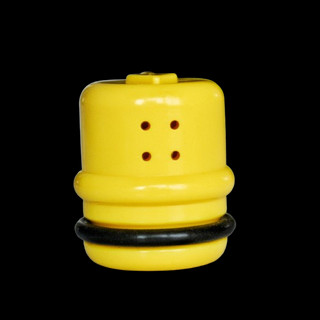
I'm Paul. I make the Holey Hiker Bidet. A few weeks ago I was on Reddit and came across two threads where people were talking about ultralight bidets. Does the Holey Hiker actually work? Why does it have four holes? People mentioned it has more pressure than other bidets, and more than a few people made a fair point: more holes doesn't mean more pressure at the nozzle. They are right. More holes do not equal more pressure at the nozzle. This manifesto is about why I designed it that way anyway.
This is quite a manifesto for a guy making little plastic bidets out of the corner of his garage.
I am a middle school teacher. That is my actual job. The bidet is the thing I do before school, after school, and on weekends. Teaching is what I have done every day for three decades, and the single most important skill that job requires is this: take something complicated, find what’s true and essential, and explain it in a way that a twelve-year-old can hold onto. Not dumb it down. Just explain it in plain language. I kinda did that :)
I have no formal science background. Zero. Unless you count that first semester I spent as a bio major, which I promise you did not help me in designing a bidet. If you are a physicist or an engineer you are welcome to fact-check everything in this post. I encourage it!
Research is something I'm pretty good at. It is something that I absolutely love. I have written more research papers than I can remember, and a few major graduation theses I will never forget, though I will warn you they are not glamorous. One was on The Influence of Scientific Management on Dairy Farming: 1850-1950. Loved that paper. Another looked at how scientific management impacted the working lives of immigrants who made shovels at the Ames Shovel Company. I had to get dirty in an old basement for that one. And one on humor's impact on the classroom. That one had the decency to at least be funny. You might be able to see how all three have shaped this product and its descriptions. Or maybe they didn’t. I have spent hours in dark archives, squinting at microfilm and turning dusty pages, trying to find the truth buried inside systems that most people never think about.
I applied the same instinct here. The archive was my backyard. The sources were a lot of honest strangers and my own backside, and the light and air quality was better.
After a lot of testing a few things became pretty clear.
I didn't want to make a piece of plastic that squirted water.
Anyone can do that. Someone already did. It was the Kulo Clean and it existed before I started tinkering, and good for them. I used it. It cleaned me. If you don't buy mine it's a good one to have. But when I looked at it I thought "that's just a hole." Just water coming out of a hole.
I wanted it to work, use less water, clean better, and be smaller and lighter. I wanted the physics to do the work, not just push water through a hole.
The problem was I had no idea what I was doing, but I did have a 3D printer.
Three Liberal Arts Degrees Walk Into a Basement
My design background: none.
My physics background: also none.
My plastics background: once again...none.
Do I use Ai to write like this: one last time…nope.
Here is what I had: a crazy imagination, a lot of free time, my 3D printer, and a growing list of strangers who were willing to take an experimental bidet into the backcountry and report back with opinions. Honest opinions.
These were not friends.
These were not investors.
These were not people who had any stake whatsoever in whether I succeeded or failed.
They owed me nothing. They knew that. Which meant when something didn't work they said so. Directly. Without cushioning.
Every single one of those people drove this bidet one step closer to what it is today.
The Desert Hiker Who Changed Everything
Early in the process, a tester came back with feedback that reframed the entire project.
She did a lot of desert hiking. Long miles, limited water, no margin for waste. Her feedback was simple: use less water or I can't use this.
That constraint felt like a wall. It turned out to be a door.
Because in trying to solve the water problem, I stumbled (largely by accident) into a nozzle design that the testers reported outperformed a single hole in every way they tested in the field: coverage, cleaning effectiveness, and water use. And I didn't fully understand why it worked until much later. I just knew that it worked. The testers told me it worked. My own backside told me it worked.
The understanding came later. The discovery came from messing around.
What I Accidentally Invented, and Why It Works
Secret #1: The bottle upside down.
Flip the bottle over and gravity immediately wants to drain it. Every drop that falls out before you squeeze is wasted, and if you're three days into a desert canyon with one water source between here and the trailhead, waste is not an option.

Tiny holes don’t let water fall through them easily.
You've probably seen this before in a sixth grade science class. How many drops of water can you put on a penny before it spills? The answer is always more than you expect, sometimes twenty or thirty, because the water domes up above the rim in a way that looks like it's breaking the rules. That dome is surface tension holding against gravity. The same force is at work inside those tiny holes.
The water wants to hold its shape.
Gravity pulls.
The surface tension skin wins until you squeeze.
When I found out this principle had a name and an equation I felt like I had been doing calculus without knowing what calculus was (which I have some experience with, having dropped my biology degree after a D-minus in Calculus).

As the opening gets bigger, surface tension becomes less effective at holding the water in. Gravity wins more easily. Water dribbles out before you're ready.
That's not a minor detail. For a desert hiker measuring every milliliter counts.
Secret #2: What happens when you squeeze.
Each tiny hole sends out its own little stream.
And here is something I did not expect when I first drilled four holes instead of one. Four streams behave better than one big one.
Think about water coming out of a wide-open garden hose versus the same hose with your thumb pressed most of the way over the end. The thumb-squeezed version shoots farther and stays together. Small openings equals a faster, cleaner jet that goes farther the harder you squeeze.
Nerd Corner: Reynolds number
Physicists use the Reynolds number to measure if water flows smooth or goes wild:
Re = ρvD/μ
In testing smaller holes made cleaner, more controlled streams. Smoother jets. Better aim. Less wild spray.
That's why the holes are the size they are. I had to account for average grip strength. Not everyone squeezes the same way, and the design had to work for all of them. Too small and only a gorilla grip would get enough flow. Too large and a gentle squeeze turns into a fire hose.
I didn't know that equation existed when I was in my backyard testing nozzles. I just knew the small holes of a certain size worked better. Physicists use the the Reynolds to understand this.
Secret #3: What actually happens between the nozzle and your butt.
The four streams don't merge into one.
Here comes another cool thing your bidet does for you without you even having to think about it.
Does four holes mean more cleaning force than one? No. Not if you measure at the nozzle. More holes means more total exit area, which means lower exit velocity per stream for the same squeeze force. The single-hole bidet hits harder. The tester who said so was not imagining it. If you are measuring pressure at the nozzle, the single hole wins.
But you are measuring at the wrong end.
Harder is not better. A single hard stream hits one spot and then the water has to travel sideways across the skin to reach everything else. Four lower-velocity streams hitting four points simultaneously means the mechanical cleaning work is already distributed across the target zone before it lands. The water does not have to travel to reach the edges. It is already there.
I actually have tester data on this. People who switched from single-hole bidets sometimes reported in the first few uses that the Holey Hiker didn't clean as well. But they weren’t brand ambassadors, they were hardcore wilderness bidet testers so they kept going. That guy in his bathroom at home was hardcore too in his own way. What they realized was that the single-hole stream had hit them harder, and harder felt like cleaner. Once they got past that initial perception, the feedback flipped. The coverage was better. The result was better.
The stream felt cleaner, but it was a psychological clean.
Forget nozzle pressure. Target coverage is what actually cleans you.
The Holey Hiker hits four points at once, covering the whole area immediately instead of blasting a single spot. Four simultaneous impact points, each one creating its own radial wash zone, meaning each droplet spreads outward from where it lands and cleans in every direction at once. Four of those zones overlapping across the target. The coverage is built into the design, not left to chance.
That's the first answer to the 'more holes means less pressure' crowd.
But there is a second answer, and I find it fascinating even now.
(If I could break here for a moment, I find all of this fascinating, and if you have made it this far, I just wanted to say that I love you too.)
Let’s start again…But there is a second answer, and I find it fascinating even now.
Those four streams don't stay as four neat cylinders of water all the way to the target. Something happens to them in flight.
Any stream of liquid traveling through air is unstable. Surface tension is constantly pulling the water toward the lowest energy shape it can find, which is a sphere, not a cylinder. So as the stream travels it pinches and swells at regular intervals, and those swells become droplets. This is called Rayleigh-Plateau instability.
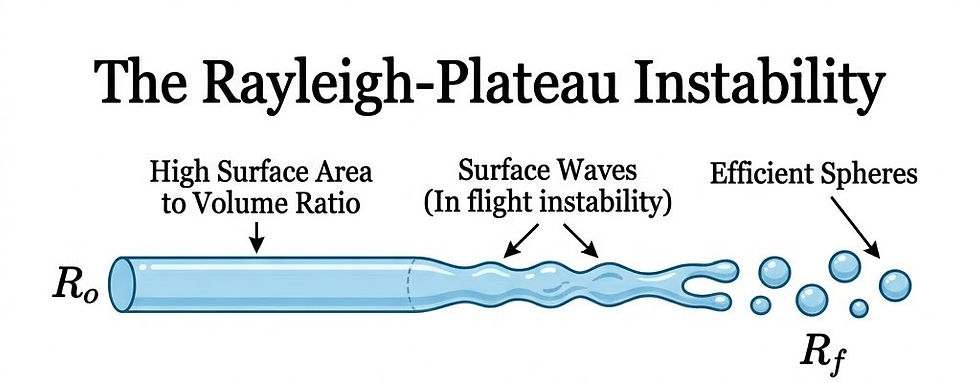
Small streams have more surface area relative to their volume, which gives surface tension more leverage, so they break into droplets faster and over shorter distances. What? Skinny streams break into droplets much faster than fat ones.
That is so cool, and I love that I accidentally figured that out.
So four small streams don't arrive as four streams. They arrive as four clusters of droplets, each one carrying its own force. Mass times velocity. Breaking into droplets changes how that force is delivered. Instead of one stream hitting one spot, the force is distributed across multiple impact points spread across the target zone.
Nerd Corner: the momentum equation
Each droplet carries momentum: p = mv, mass times velocity. When four streams break into four clusters of droplets, those values of momentum don't disappear. It just spreads across more impact points. The total cleaning work done across the zone can equal or exceed a single harder stream, even at lower individual velocity.
Imagine those droplets hitting your crack. Surface tension wants to keep them round, like a little ball. But there is a contest. If a droplet hits gently, surface tension wins and it sits there in a bead doing nothing. If it hits hard enough, the impact wins and the droplet splats outward in all directions, pushing material away from the center.

Nerd Corner: droplets that actually spread
Physicists use something called the Weber number to keep score in the battle between a droplet's momentum and its surface tension. Low score, the droplet stays round. High enough score, it splats radially outward. That splat is not just a splash. It is a mechanical cleaning event. You want the splat.
Four clusters of droplets hitting four points simultaneously, each spreading on impact, each one creating a radial wash zone that overlaps with the others, covering the entire target zone at once.
You feel it as coverage, not pinpoint pressure. The difference between someone poking you with one finger versus pressing four fingers down at once.
So yes, the single hole wins at the nozzle but you don't clean with the nozzle. You clean at the target.
Secret #4: The geometry, which is where the year of experimentation actually lived.
The hole spacing is where two forces are fighting, and my job was to find the truce point between them.
The first force is divergence.
Water exits a small hole and immediately starts spreading outward. The four streams are actively moving further apart as they travel. Four tight streams leave the nozzle and a wider, more useful cluster of droplets arrives at the target. The bidet's job ends the moment the water leaves the nozzle. From there it hands off to physics. The water arrives better than it left.
The second force is the tendency of nearby jets to interact with each other.
Too close and the streams merge into one jet almost immediately.
You lose the coverage pattern, the multi-point impact, and you are essentially back to one stream. You bought a water pistol to clean an elephant.
Imagine holding four flashlights close together, pointing them at a wall. Each beam spreads as it travels. If the flashlights are too close, the beams overlap into one big blob. Too far apart, and you get four separate circles with dark gaps between them. The sweet spot is when the beams overlap just enough to cover the whole wall without waste.
That's exactly what the hole spacing solves.
Too far apart and the pattern spreads beyond the target zone, splashing water in places you don't need it.
Too close and you lose the coverage entirely.
The hole spacing on the Holey Hiker is my answer to that. Close enough that the streams stay in a useful cluster all the way to the target. Far enough apart that the coverage area is wider than the nozzle face and the droplets have room to work.

Nobody told me that spacing. I found it by printing and testing, one 65-minute print at a time, one poop at a time, in my backyard, during a pandemic. Most of my year of tinkering was tweaking that spacing around until the pattern at real butt-distance was right.
And hole size was its own separate experiment running alongside the how far apart to put the holes experiment. Experienced bidet users wanted smaller holes. First timers wanted bigger ones. The difference in what they were asking for, when I measured it out, was adjustments of half a millimeter at a time. That is how precise this got. Half a millimeter changed the feel enough that different users had a strong opinion about it. In the end I went with something slightly larger than the experienced users wanted and slightly smaller than the newbies wanted.
And that is the answer to why four holes and not one, regardless of size. One hole cannot create that tension. The physics only becomes interesting, and the cleaning only becomes fully effective when there are four.
What gave me the time to do any of this?
The world slowly started shutting down and on March 13, 2020 my school shut down for the remainder of the year.
COVID sent me home and gave me the exact conditions a one-person bidet design project needs. No commute. No getting dressed. No prepping lunch. Suddenly there were a couple extra hours in every day that hadn't existed before. I had a big backyard and a 3D printer and a growing list of strangers willing to test a bidet.
I went outside every morning.
I tested.
I came back inside.
I made changes.
I started printing another one and then tried to keep 25 eighth graders engaged on a video call.
Some changes worked and I understood why. Many changes worked and I had no idea why, and I kept going. A few changes were disasters that taught me more than any success did.
I had no deadline.
No investors.
I didn't even know with certainty this would ever become a real product or just a weird hobby.
What I had was time. That is rare in product development, and I didn't fully appreciate it until later. That is, I think, why it actually works.
The Part About Posture Nobody Will Tell You
Posture matters more than the bidet.
Squat.
Actually squat.
Spread your cheeks.
Use your hand to spread em'.
This is not optional.
Think about the geometry for a second. The target here is a small opening. In a full squat with everything spread apart, the surface area you actually need to clean is small. The skin around it is taut and accessible. The stream arrives at the actual target and does its job.
A Western toilet seat compresses everything. Cheeks press together. Angles close off. The target becomes recessed, folded, harder to reach.

There is also a muscle, called the puborectalis (I have to look that one up every time), that wraps around the lower end of the digestive tract and creates a slight kink when you're sitting or standing upright. It keeps things in until you choose.
Squatting releases it.
The exit becomes straighter, cleaner, and more complete.
Less residual material.
Smaller cleanup job.
Bad posture can defeat the physics making the bidet work harder than it needs to.
The protocol is three words: Squat. Spread. Squeeze.
In that order. Every time. This is most of the game.
Squat low enough that the actual target is exposed and not pressed into the seat.
Spread em' so the skin is taut and the stream has a clear line of sight.
Squeeze only once you know the water has an unobstructed path to the part that needs cleaning.
One more thing that nobody tells you. Relax.
When the water hits, most people tense up. Resist that. Your body uses two different sphincters and they have two different jobs. The internal one is involuntary. It does its own thing. The external sphincter is the one you actually control. It is the one that slams shut in response to sensation or surprise, like when cold water from a bottle hits your crack in the middle of the woods.
You have to consciously override that reflex.
Don't strain. Don't brace. Stay open and relaxed. Think of it like taking a deep breath before something uncomfortable. That breath helps your whole pelvic floor let go.
Squat opens the angle. Spread opens the approach. Relax opens the target itself.
All three matter. Most people only do one.
A Brief Note on Why Some People's Poop Is Harder to Clean Than Others
Yes this is a real thing.
Yes the science is real.
No it is not a you problem.
Yes Ai loves to write in triplets but so do I….ug.
Here's the simple version of why your poop might be sticky. Bet that was not a sentence on your bingo card for today :)
Poop is partly water-friendly and partly fat-friendly.
The water-friendly parts rinse away easily. The fat-friendly parts don't, because fat and water refuse to cooperate. Think of trying to rinse a greasy pan without soap. The water beads up and rolls off and the grease stays put. The chemistry behind this is called hydrophobicity, which is a long word for "water, go away." Greasy poop naturally repels water. High-fat stool behaves like a hydrophobic surface. The water that lands on it is not washing it. It is sliding around it.
What water can do is hit hard enough to physically dislodge material through force alone. This is exactly why the four-hole pattern matters most on sticky days. Those droplets are arriving with real momentum, hitting the full target zone simultaneously. Those tiny drops hit fast, spread out, and knock the mess loose. Each one spreads on impact and pushes material away from its own point of contact. This is water doing everything it is physically capable of doing and being delivered as efficiently as possible.
There is also a technique that helps. You need to do it.
Pre-spray your crack before you go. ← so important I put it in bold
Pre-spray your crack before you go. ← so important I increased font size
A thin film of water sitting on the skin before anything arrives prevents the fat-friendly components from making direct contact with the surface. They land on the water instead of on you. The cleanup afterward is genuinely easier.
Squeeze before. Squeeze after.
Nerd Corner: The Thru-Hiker Advantage (or, Why Day Three Is Easier Than Day One)
I cannot prove this with a controlled study. But I did develop a formula to capture the "Cleanability" of any given backcountry bowel movement. In my backyard laboratory, we call it The Paul Number.

Not peer-reviewed. Not submitted for publication. But the logic is sound: The people who say bidets don't work are usually pooping their pre-trip life. Give it a few days. The trail fixes things.
If you made it this far I love you even more, and you are so close to the end!
When you put a Holey Hiker onto your bottle and squeeze, you are now one of a fairly small number of people who knows exactly what is happening inside that stream.
Surface tension held the water until you were ready.
Fluid dynamics kept each stream behaving in a controlled way.
Rayleigh-Plateau broke them into droplets in flight.
Spacing and jet interaction held the pattern together just enough and spread it just wide enough.
Four clusters of droplets arrived at the target simultaneously, each one spreading on impact, covering the whole zone at once.
You don't just squeeze water out of a bottle.
You squeeze out four years of trial, error, and accidental discovery, prototypes every 65 minutes, a pandemic that accidentally gave me the hours, a backyard full of catholes, and a lot of honest feedback from very accommodating backsides.
What you have read is what I know to be true right now, tested in my backyard, confirmed by a lot of honest strangers, and explained as accurately as I can manage.
But I am still working on some things.
Bottle size. Amount of water remaining in the bottle. Hand size and grip strength. Bottle angle at the moment of the squeeze. All of these almost certainly affect what arrives at the target, and I do not yet have a clean physics story for any of them. I have hunches and observations. I do not have formulas.
If you do, I would genuinely love to know.
One request. I am a real person. This is something I built with my own hands over years, and I care about getting it right. If you have a correction, a better formula, or something I missed, I welcome it with genuine gratitude. What I do not welcome is being talked to like I am an idiot who wandered into physics by accident and deserves to be put in my place. I know I wandered into physics by accident. That is literally the whole story.
Approach with humility and grace and I will do the same. Come in swinging and I would honestly rather stay wrong. I spend my days managing the emotional landscape of twelve year olds. I do not have the bandwidth at night for the same energy from a grown adult attacking a mistake I made about a bidet.
This is not a peer reviewed journal. It is a manifesto about a backpacking bidet written by a middle school teacher who spent a pandemic in his backyard. Treat it accordingly.
Less Wiping. More Hiking.
That's it. You now know exactly how the Holey Hiker Bidet works. You're part of it now. Welcome to the story.
Paul is the CEO, designer, lead tester, and sole employee of Holey Hiker Bidets. He has goats, and an opinion about squat posture.
Comments